Political Communication & Governance
The Political Communication & Governance program will no longer be offered as a separate Master’s program.
The content related to political communication will be integrated into the specialised Master’s program Strategic Communication & Management as well as into the consecutive Master’s program Communication Science and Media Research.
Governance-related topics will likewise be incorporated into the consecutive Master’s program.
From political advertising on social media to disinformation, from platform regulation to algorithm-driven content curation – digital transformation is fundamentally reshaping how politics is communicated, perceived, and governed. The relationship between politics, the media, and the public is now at the heart of a constantly evolving negotiation.
The specialized Master’s program in Political Communication & Governance offers comprehensive insights into current trends in political communication and the regulatory challenges they pose. Students explore the growing influence of digital platforms on public opinion, the emergence of new strategies by political actors – such as microtargeting – and evolving forms of civic engagement in digital environments. The program also examines the role of artificial intelligence in political communication: How do automated systems transform political campaigns? What impact do chatbots and synthetic media have? And how can transparency and democratic oversight be maintained?
Key questions are addressed throughout the curriculum: What influence do major platforms like Google and Meta have on the visibility of political content? How does digital communication shape knowledge, emotions, and behavior? And what governance tools are necessary to safeguard democratic processes and ensure a vibrant, pluralistic public sphere?
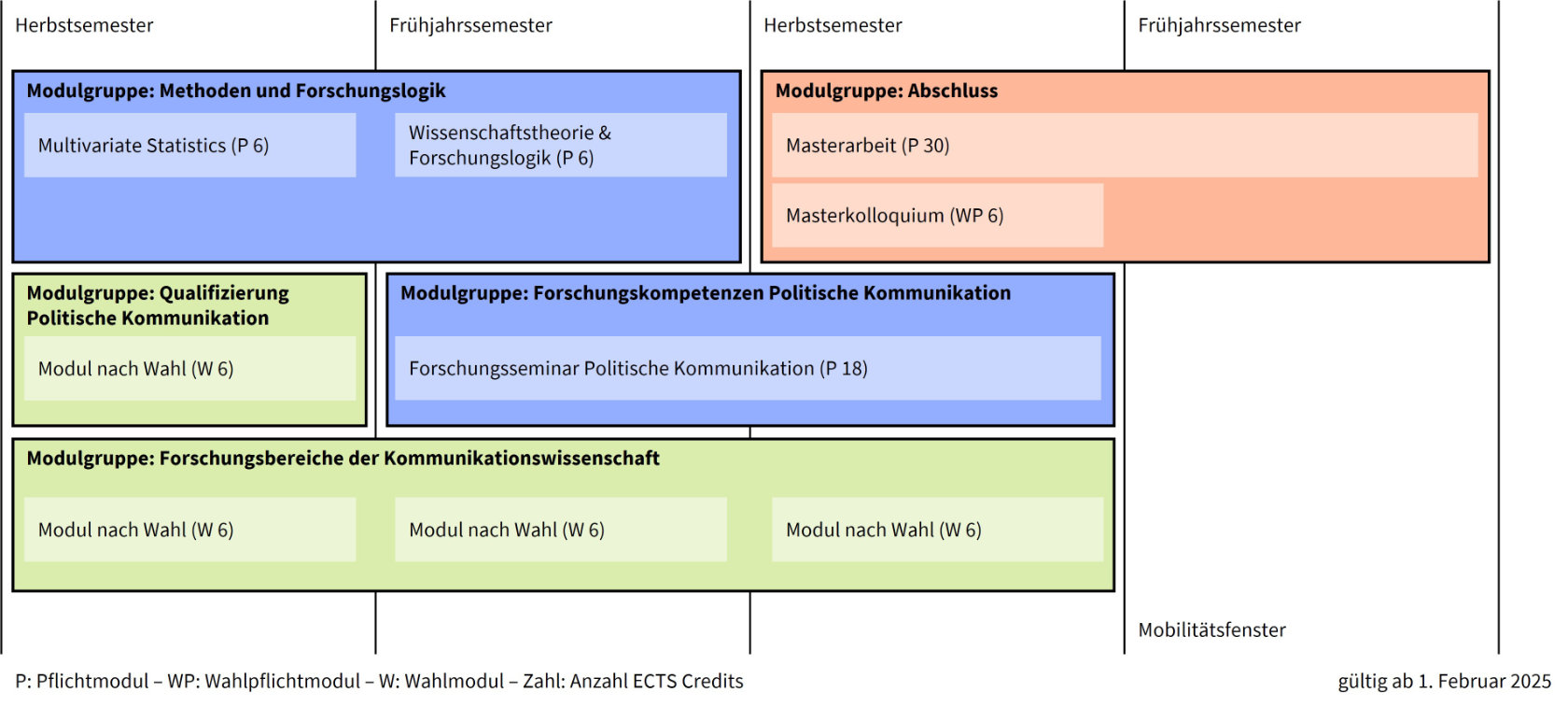
The sample curriculum illustrates one of several ways to plan your studies. It outlines a full-time program over four semesters. In the major/minor model (totaling 120 ECTS credits), you will typically complete around 30 ECTS credits per semester. It is also possible to take a reduced course load per semester, in which case the duration of your studies will be extended accordingly. The major study program Political Communication & Governance can be started in the fall or spring semester.
Please note: The main language of instruction is German.
Below, you will find the key documents for the MA Major in Political Communication & Governance:
Appendix to the study regulations
Module catalogue
Sample curriculum
Program structure: module groups and modules
The degree program is structured into module groups, each with specific passing requirements as outlined in the appendix to the study regulations. Some modules build upon others or are only available in either the fall or spring semester. Detailed information on prerequisites and course offerings can be found in the module cata-logue and the page Getting Started.
Research Design and Methods (compulsory modules in the Major & Minor):
- Multivariate Statistics (6 ECTS)
- Theory of Science and Principles of Research (6 ECTS)
Research Areas Communication Science (elective lectures):
At least 3 modules of 6 ECTS of your choice
Can be booked without prerequisites, offered every semester.
Qualification Political Science (seminar):
1 specialized seminar of 6 ECTS
Can be booked without prerequisites, usually offered in the fall semester
Research Competencies Political Communication (research seminar):
1 research seminar of 18 ECTS spread over two semesters
Starts in the spring semester, continues in the fall semester
Final Modules:
- Master's thesis (30 ECTS)
- Master's colloquium (6 ECTS)
See the page Master's Thesis and Final Modules for more information.