Getting Started
You've made an excellent choice. IKMZ (Department of Communication and Media Research) is not only one of the largest departments of its kind worldwide, but also one of the most highly regarded, as confirmed by leading international university rankings. Our focus is on communication science and media research as a social science subject, enriched by strong interdisciplinary connections and collaborations. In our Bachelor's and Master's programs, we offer comprehensive education that covers the full spectrum of the field – from foundational theories to cutting-edge developments. We place particular emphasis on current topics such as the digital transformation of the media landscape and the role of artificial intelligence across different phases of the communication process.
We wish you an inspiring and successful time studying with us!
Getting started with your studies: what you need to know
University vs. high school
University life is quite different from high school. You’ll be expected to manage your own schedule, meet academic deadlines independently, and navigate a more research-driven learning environment. Learn more about the key differences to help you transition smoothly.
UZH login and UZH card
You’ll receive your UZH login credentials and your UZH Card along with your admission documents. These are essential for managing your studies.
Student portal
The student portal is your central platform for all study-related administration. With it, you can:
- Create your personal timetable
- Book modules
- Access grades and academic progress
- Manage various administrative tasks
You’ll find step-by-step guides and key information on how to use the portal effectively on the UZH website Study Organization.
Your responsibility to stay informed
As a student, it’s your duty to keep yourself up to date with deadlines, procedures, and university regulations.
- Regularly check your UZH email (at least once a week).
- All official notifications, decisions, and decrees are sent exclusively via email.
- Make sure to review documents published in the student portal.
Important dates and deadlines
All relevant semester dates, registration periods, and submission deadlines are listed on the Faculty of Arts and Social Sciences website – from module booking to graduation.
About the Department of Communication Science and Media Research (IKMZ)
The University of Zurich (UZH) is organized into seven faculties, each comprising several departments.
Your major determines your faculty.
The Department of Communication Science and Media Research (IKMZ) belongs to the Faculty of Arts and Social Sciences (PhF). The PhF is the largest faculty at UZH, with over 10,000 students and more than 120 degree programs.
IKMZ has a history dating back to 1903 and is Switzerland’s largest institute for communication studies. Approximately 80 people teach, research and work at IKMZ, – supported by external lecturers and student assistants – and serve around 1,200 students. The department comprises 12 professorships covering the full range of the discipline.
IKMZ locations
UZH operates across four main campuses:
- UZH City Campus
- UZH Irchel
- UZH Oerlikon (home of IKMZ)
- UZH Schlieren
Most IKMZ courses are held at Andreasstrasse 15 (AND) in Oerlikon, but some also take place at UZH City Campus and UZH Irchel. A free shuttle bus connects UZH City Campus and UZH Oerlikon during breaks and lunchtime. More information can be found on the UZH page Finding your way around.
Getting involved: IKMZ student association
The IKMZ student association (Fachverein Communication) represents student interests, foster communication with the department, and organizes events such as:
- Company visits
- Graduation celebrations
- Alumni talks
- Social events and parties
All members work on a volunteer basis and are in close contact with other university associations.
Interested in joining? Register here: fvcom@ikmz.uzh.ch
Learning platform: OLAT
During your studies, you will use OLAT (Online Learning and Training) to access course materials and other resources provided by the lecturers.
- Once you’ve booked a module, you’re automatically enrolled in the corresponding OLAT course.
- Access your courses via the "Active" tab under "Courses".
To log in, you need a Switch edu-ID account that is linked to your UZH account. Please follow these instructions to learn how to proceed.
Stay informed: Mailing list
Subscribe to the Communication science mailing list to receive important updates on:
- Events and info sessions
- Exchange programs
- Internships and job postings
- Research project opportunities
- Student assistant openings
Don’t miss out – sign up today!
Where to go with questions
Choosing or changing degree programs
Your first point of contact for questions about degree program selection or changes is the UZH Student Advisory Services.
Application & admissions, study certificates, semester fees, access data
The Student Administration Office is responsible for:
- Admission to Bachelor’s programs for students with Swiss high school qualification
- Program changes, leave of absence, withdrawal
- Tuition billing and certificates
The Admissions Office handles:
- Admission to Bachelor’s programs for students with foreign high school qualification
- Admission to Master’s programs for non UZH students
Student Services will answer your questions about:
- Admission to a Master’s program at the Faculty of Arts and Social Sciences
General questions about studying
Student services at the Faculty of Arts and Social Sciences is your first point of contact for general, non-subject-specific questions related to the organization of your studies (e.g. applications, confirmations, adjustments for students with disabilities, or using the student portal).
Study programs and modules in communication science
The Student Advisory Service at IKMZ is available to answer your questions about course content and structure, module requirements, and course or examination dates in the IKMZ study programs. Questions about studying abroad? Please contact us via email at: mobility@ikmz.uzh.ch
Module booking
If you encounter technical problems with module booking during the official booking period, please send an email to: modulbuchung@phil.uzh.ch
Degree completion
If you are already registered for a degree and have related questions, please contact: abschluss@phil.uzh.ch
Doctoral program
If you have questions about the doctoral program, please reach out to the doctoral coordinator, Doreen Spörer-Wagner, at: doreen.spoerer-wagner@phil.uzh.ch
Additional advisory services
UZH offers a wide range of support and advisory services for students, including: psychological counseling , financial aid, studies and family life, time management, and career services to support your transition into the professional world.
Students with disabilities or chronic illnesses can obtain guidance from the Disability Office (FSB) on how to study in a barrier-free environment and what forms of compensation are available. We recommend contacting the FSB early in your studies. Details on how to submit the necessary documentation and deadlines are available on the Faculty of Arts and Social Sciences website.
Planning your studies
There are no fixed timetables at IKMZ. The sample curriculum (MC) – Important Documents Bachelor’s Degree / Master’s Degree – offers a suggested way to distribute modules across semesters, but you are free to design your own course of study. The study plan and its accompanying passing requirements form the essential foundation of your studies. You must complete all modules according to the study plan to graduate. You’ll find the study plan in the appendix to the study regulations (ASTO) – Important Documents Bachelor’s Degree / Master’s Degree.
Module groups
The degree program is divided into different module groups. Each module group has its own specific passing requirements, which are outlined in the appendix to the study regulations (ASTO) – Important Documents Bachelor’s Degree / Master’s Degree. The course catalog and the "Study Progress & Graduation" app in your student portal are also organized according to these module groups.
Modules and module types
A module includes one or more courses and always involves an assessment. The Faculty of Arts and Social Sciences distinguishes between the following types of modules:
- Compulsory modules (P-modules)
These must be passed successfully. Failing a compulsory module twice will result in exclusion from the program and a subject ban. Compulsory modules are offered regularly. You can find the scheduling pat-tern in the module catalogue (MK) – Important Documents Bachelor’s Degree / Master’s Degree – or course catalogue under the keyword "Organization". - Core elective modules (WP-modules)
The number of WP modules required per module group is defined in the curriculum (passing require-ments). If you fail a WP module twice, you must replace it with a different one. These modules are also offered regularly; see the module catalogue (MK) – Important Documents Bachelor’s Degree / Master’s Degree – or course catalogue for details under "Organization". - Elective modules (W-modules)
These must also be completed according to the curriculum's passing requirements. Failing an elective module simply counts as a failed attempt but has no further consequences. Depending on the program, elective modules may be offered regularly, irregularly, or only once. Check the course catalogue for the current offerings.
Semester program
You’ll find information on modules offered in the current semester in the course catalogue. It lists all courses of-fered at UZH per semester. Navigate as follows: Faculty of Arts and Social Sciences → Bachelor of Arts in Social Sciences or Master of Arts in Social Sciences → Your study program (e.g. Major 120 → Communication Science and Media Research).
Part-time studies
All of our programs can be studied part-time. There is no minimum number of ECTS credits you must complete per semester. You are free to design your own individual course plan. After exceeding twice the standard study duration, the tuition fees double (e.g. after 12 semesters for Bachelor and 8 semesters for Master students).
Customizing your course of study
The sample curriculum (MC) – Important cocuments Bachelor’s degree / Master’s degree – is only a suggestion. You may adapt your study plan – for instance, if you’re studying part-time or starting in the spring semester.
When customizing your plan:
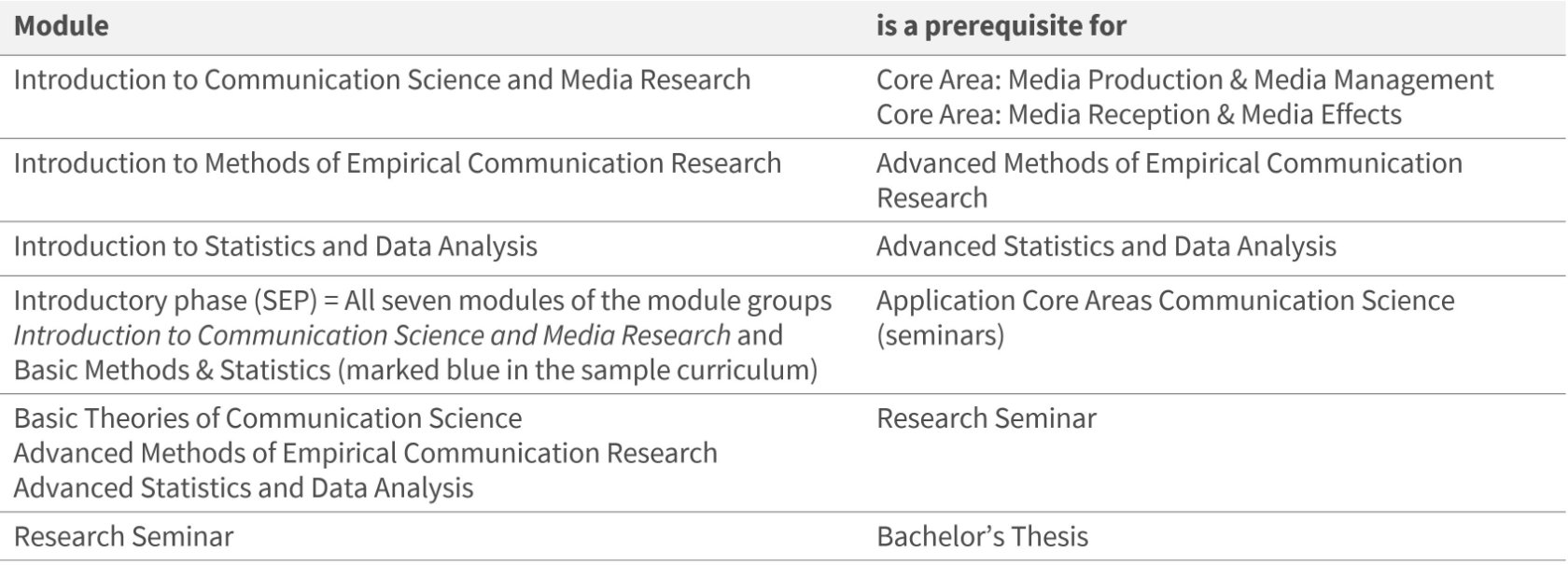
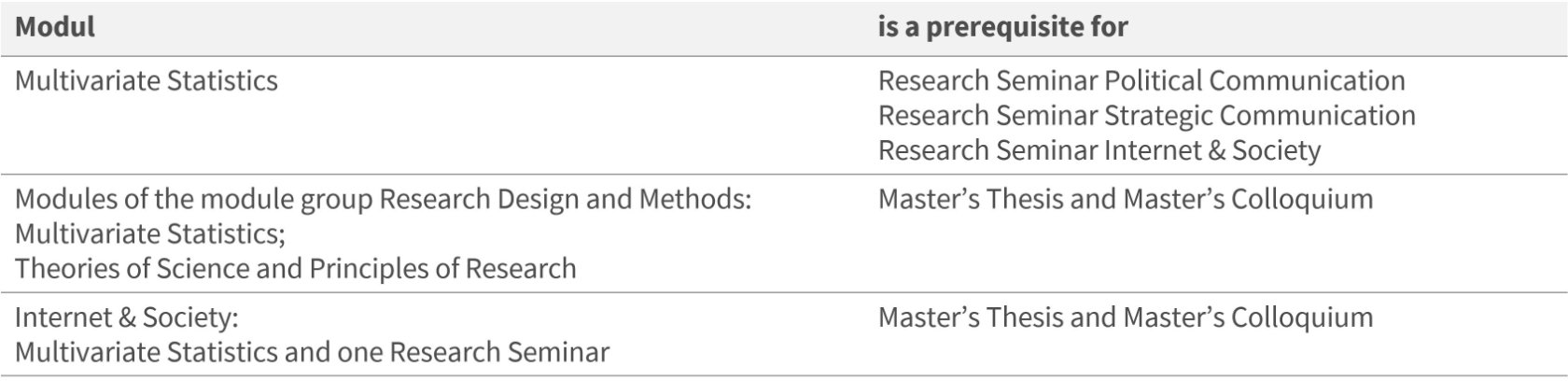
- Check for prerequisites: Some modules may require you to have passed other modules or have specific prior knowledge (e.g. introductory and methods modules).
- Pay attention to frequency: Some compulsory modules are only offered in either the fall or spring semester. You can find this information in the module or course catalog.
You can find this information in the module catalogue (MK) – Important Documents Bachelor’s Degree / Master’s Degree – or course catalogue.