Bachelor
The Bachelor's program in Communication Science and Media Research offers a solid foundation in social science theory, current research insights, and empirical-methodological skills. Students develop theoretical, meth-odological, and organizational competencies that prepare them for a broad range of professional fields – such as media and opinion research, the evaluation of communication services, public relations and organizational communication, media production and marketing, as well as education and training. Communication Science and Media Research can be pursued as a major (120 ECTS) or minor (60 ECTS) within the Bachelor's degree.
Communication Science and Media Research as a major
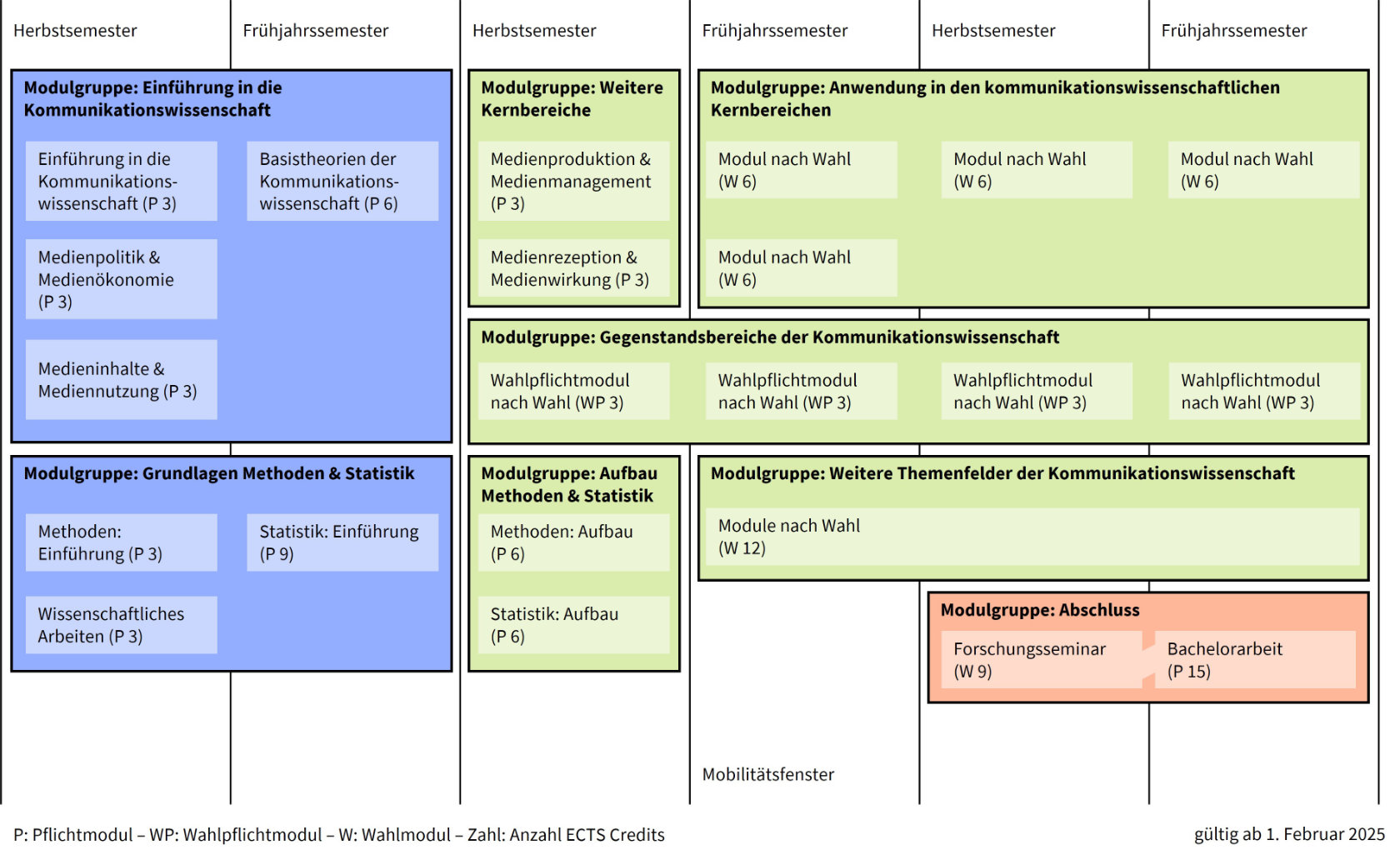
The sample curriculum illustrates one of several ways to plan your studies. It outlines a full-time program over six semesters. In the major/minor model (totaling 180 ECTS credits), you will typically complete around 30 ECTS credits per semester. It is also possible to take a reduced course load per semester, in which case the duration of your studies will be extended accordingly. For the major in Communication Science and Media Research, we recommend beginning your studies in the fall semester. However, you have the flexibility to tailor your individual course of study (see the page Getting Started for more information).
Please note: The main language of instruction is German.
Below, you will find the key documents for the BA Major in Communication Science and Media Research:
Appendix to the study regulations
Module catalogue
Sample curriculum
Communication Science and Media Research as a minor
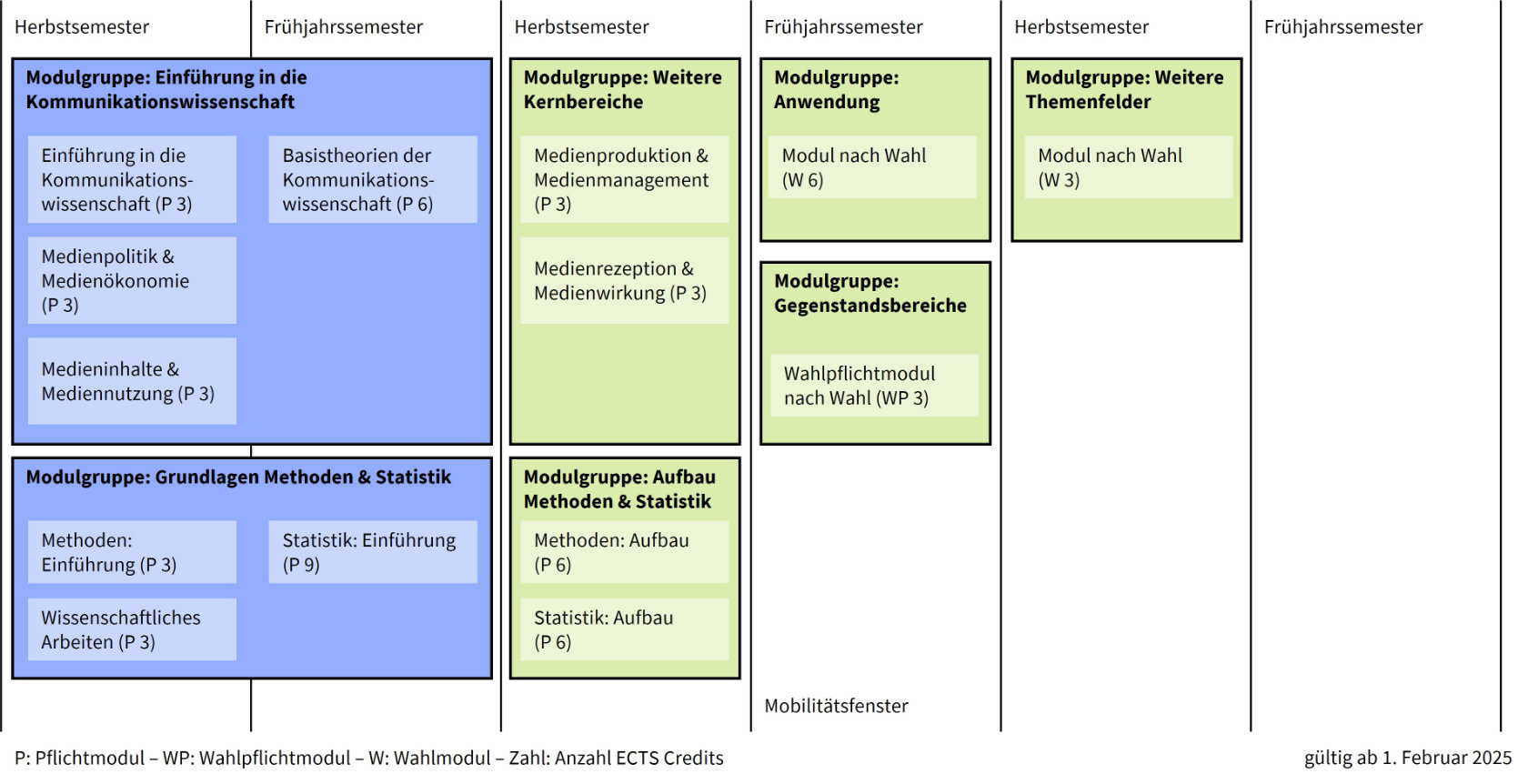
The sample curriculum illustrates one of several ways to plan your studies. It outlines a full-time program over six semesters. In the major/minor model (totaling 180 ECTS credits), you will typically complete around 30 ECTS credits per semester. It is also possible to take a reduced course load per semester. You have the flexibility to tailor your individual course of study (see the page Getting Started for more information).
Please note: The main language of instruction is German.
Below, you will find the key documents for the BA Minor in Communication Science and Media Research:
Appendix to the study regulations
Module catalogue
Sample curriculum
Study structure: module groups and modules
The degree program is structured into module groups, each with specific passing requirements as outlined in the appendix to the study regulations. The program is generally divided into two phases:
- Introductory Phase (SEP): Ideally completed during the first year of study
- Qualification Phase: Begins after successful completion of the SEP (Studieneingangsphase)
Some modules build upon others or are only available in either the fall or spring semester. Detailed information on prerequisites and course offerings can be found in the module catalogue and the page Getting Started.
Introduction to Communication Science / Basic Methods & Statistics (SEP)
(compulsory modules in the Major & Minor):
- Introduction to Communication Studies (3 ECTS)
- Basic Theories of Communication Science (6 ECTS)
- Core Area: Media Policy & Media Economics (3 ECTS)
- Core Area: Media Content & Media Use (3 ECTS)
- Academic Work (3 ECTS)
- Introduction to Methods (3 ECTS)
- Introduction to Statistics (9 ECTS)
Advanced Methods & Statistics (compulsory modules in the Major & Minor):
- Advanced Methods (6 ECTS)
- Advanced Statistics (6 ECTS)
Other Core Areas (compulsory modules in the Major & Minor):
- Media Production & Media Management (3 ECTS)
- Media Reception & Media Effects (3 ECTS)
Subjects Communication Science (core elective modules):
In the major: min. 12 ECTS | In the minor: min. 3 ECTS
Examples: Media Ethics, Media Law, Audience Research, Advertising, History and Sociology of Media
Application Core Areas (elective seminars):
Prerequisite: completion of SEP
In the major: min. 24 ECTS | In the minor: min. 6 ECTS
Freely selectable seminars in the field of communication science and media research.
Further Topics (elective lectures):
In the major & minor: min. 3 ECTS
Freely selectable lectures in the field of communication and related disciplines.
Final Modules (Major only):
- Research seminar (9 ECTS, only offered in the fall semester)
- Bachelor's thesis (15 ECTS, in the spring semester, following the research seminar)
The research seminar lays the foundation for the Bachelor's thesis; concepts and methods for the Bachelor's thesis are prepared. See the page Bachelor’s Thesis and Final Modules for more information.